

The key to creating a sustainable organization (including churches and parachurch ministries) is its ability to regenerate and grow their staffing and leadership through generational turnover. We will explore a solution that may sound strange, yet somewhat familiar: The Staff Discipleship Model.
What is discipleship?
Our friends at Merriam-Webster define discipleship as “the state of being a follower or student who adheres to the doctrine and precepts of a teacher.”
Let’s now ask, what is church discipleship?
Usually, the answers may fall into these three categories, which we call the three “F”s.
- Follow Jesus
- Fellowship
- Fish for Others
There are plenty of discipleship models in the Bible.
- Jesus and His 12 apostles
- Paul and Timothy
- Naomi and Ruth
- Moses and Joshua
- Mordecai and Esther
As we examine these discipleship relationships, there are recurring themes that characterize a good discipleship relationship. Common bonds include:
- Deep familial commitment: Life-on-life relationships where both parties are deeply connected and bonded in trust. (EX: Paul affirming Timothy in his service following Paul “as a son to a father” (Phil 2:22))
- Humility with both parties: Unselfishly mentoring out of deep care, equipping the mentee for greater responsibility (and succession), and for the mentees to receive and respond obediently. (EX: Moses publicly passing the leadership baton in Deuteronomy 31:7)
- Speaking truth in love: No sugar coating but sharing truth (EX: Mordecai exhorting Esther to risk her life for her people “for such a time as this” (Esther 4:14))
Successful discipleship relationships are collaborative. The mentor needs to have the humility to be open and learn from others including the mentee.
Marketplace Discipleship Lessons
I accepted Christ in college. I graduated with an engineering degree, began working in Silicon Valley, and was promoted into leadership fairly quickly. My conundrum was, “How can I be salt and light to the world in my job where I (and most Americans) spend most of my waking hours?”
I was fortunate enough to work at a couple of firms that had a strong values-based culture. It was a great training ground for me to discover vocational discipleship. These organizations, Hewlett-Packard and Watkins Johnson, had a deep respect for people and invested in their potential.
This was epitomized by one central axiom at Watkins Johnson. It was called the “Hit by a Truck” goal (HiBaT). As a leader, we were tasked with developing our staff so that if we were absent, there would be at least one direct report who was fully trained to step in and perform seamlessly. Every supervisor and executive had this as an accountable performance review goal.
This forced managers to develop their staff. They had to transform into mentors and coaches. We engaged with our employees, and asked:
- What roles can they grow into?
- Do they have the skills and/or potential to do my job?
- Do they even want my job?
This provided an opportunity for me.
What if I could leverage this responsibility to exercise my Christ-centered calling to love on my staff, and in doing so, be salt and light in this world in Silicon Valley?
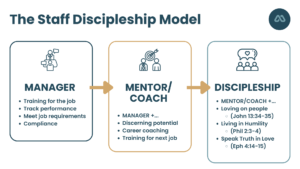
The Staff Discipleship Model
Remember the recurring discipleship themes that were characteristic of Biblical mentor/mentee relationships mentioned earlier? They were:
- Deep familial commitment
- Humility with both parties
- Speaking truth in love
I took the HiBaT goal and imprinted these principles into the mentoring and coaching process, resulting in what I now call The Staff Discipleship Model. The Biblical pillars I leaned on were:
- Loving on People: “A new command I give you: Love one another. As I have loved you, so you must love one another.By this everyone will know that you are my disciples, if you love one another.” – John 13:34-35. This calibrated me to be a caring mentor.
- Living in Humility: “Do nothing out of selfish ambition or vain conceit. Rather, in humility value others above yourselves, not looking to your own interests but each of you to the interests of the others.” – Philippians 2:3-4. This gave me humility to avoid the insecurity about being replaced while focusing on helping my staff become better versions of themselves.
- Speaking Truth in Love: “Instead, speaking the truth in love, we will grow to become in every respect the mature body of him who is the head, that is, Christ.” – Ephesians 4:15. This is critical for any mentor or coach. True growth needs to be grounded in reality, which may be adverse at times (EX: sharing weaknesses they possess or subpar performance). Messaging it in an affirming manner, grounded in your desire for what’s best for them, is key in building trust and real growth.
Assessments
Assessments are core tools in my mentoring and coaching process. Questions that arise are:
- Supervisor: What is the growth potential that I can envision this employee becoming in the organization? Based on how God has designed this brother/sister-in-Christ, how can I help them grow into their potential?
- Employee: What is my calling and desire to grow in my Kingdom work? And how do I get there? Where do I want to be in the future?
To answer these questions, we need to do an inventory to assess:
- What are your gifts and talents?
- What role do you aspire to?
- In what areas do you need to grow?
Assessments are tools that can provide clarity in identifying these areas for development. They provided self-awareness, which is also key to learning.
Without doing a deep dive into specific assessment tools, we do recommend the following:
- Use assessments that meet EEOC (Equal Employment Opportunity Commission) standards: This will help your organization avoid discrimination lawsuits.
- Use more than one assessment tool: Each assessment takes a 2D picture that will disclose certain truths. Multiple assessments from different perspectives provides a comprehensive 3D picture of the individual.
- Use the right assessment tool to discover job fit: Do they possess the right skills? Will their behavior and communication style work well with the team? Is there alignment with our culture and values?
The Discipleship Challenge in the Church
Meaningful discipleship happens on a life-on-life basis. This is not to say that discipleship does not occur on some level from sermons, in a classroom, or in a Bible Study or Life group. But the lack of personalized collaborative discussions and personal application of Biblical guidance makes these methodologies less effective as the life-on-life model.
The parties in discipleship are:
- Mentee: Someone who has a desire to be discipled and developed.
- Mentor: Someone who is equipped and has a desire to disciple someone.
The challenge in the church to developing mentor/mentee discipleship connections is that there is a lack of connecting mechanisms in the church.
The Staff Discipleship Model begins to address this lack of connection. Imagine if every church leader embraced the responsibility to not just manage their staff but to disciple them to become better versions of themselves spiritually and vocationally? Imagine if they modeled this with every layer of staff? And what if this modeling extends to the lay leaders of the congregation? And they in turn to other congregants? You see, in the organizational staff structure, there already exists a supervisor/employee relationship. The Staff Discipleship Model transforms these into discipleship relationships.
Filling the Talent Pipeline
Every staff member in every organization (church, ministry, corporation) is temporary. Everyone eventually leaves. It is leadership’s responsibility to be able to fill these eventual job openings quickly. By far, the best and most seamless way of doing that is developing talent internally. This includes volunteers as potential accessible internal talent. Implementation of the Staff Discipleship Model does not just apply to supervisors. Non-supervisory staff should also be tasked with cross-training to allow people to fill in if they were absent.
Reflect on your own church or organization. Are there any individuals, if they were suddenly unable to work, who would create an operational gap or even a shut down because there is no one cross trained?
Leadership Succession
If the Staff Discipleship Model is practiced well throughout an organization, leadership succession is automatically addressed. Our organization has touched many churches and ministries where there is no clear successor, nor is there any mentoring or discipling taking place to provide a successor. In these cases, there is a virtual guarantee that when their leader transitions, there will be disruption potentially in the form of:
- Ministry impact
- Donor/giving reduction
- Potential staff loss
- Congregants leaving
The ideal time to address succession is on the first day of employment. Governing Boards must have succession on the agenda, and not only for the lead pastor, but also for the Board Members themselves. Unfortunately, we have encountered many Board members who are out of touch with the ministry, and are not fully executing their responsibilities well, including building up the Board to a higher level of capability and impact.
Conclusion
The solution to the succession challenge in the church is to model Biblical discipleship to its congregation. The Staff Discipleship Model provides a sustainable framework through which churches can embrace, as part of their ongoing culture, a model of continuous growth. Developing your talent pipeline, leadership succession, and Board development are addressed in the Staff Discipleship Model. Coupled with the use of assessments, this model will provide a sustainable solution in maintaining your church growth and magnifying its Kingdom impact.
About the Author: Bill Tom
